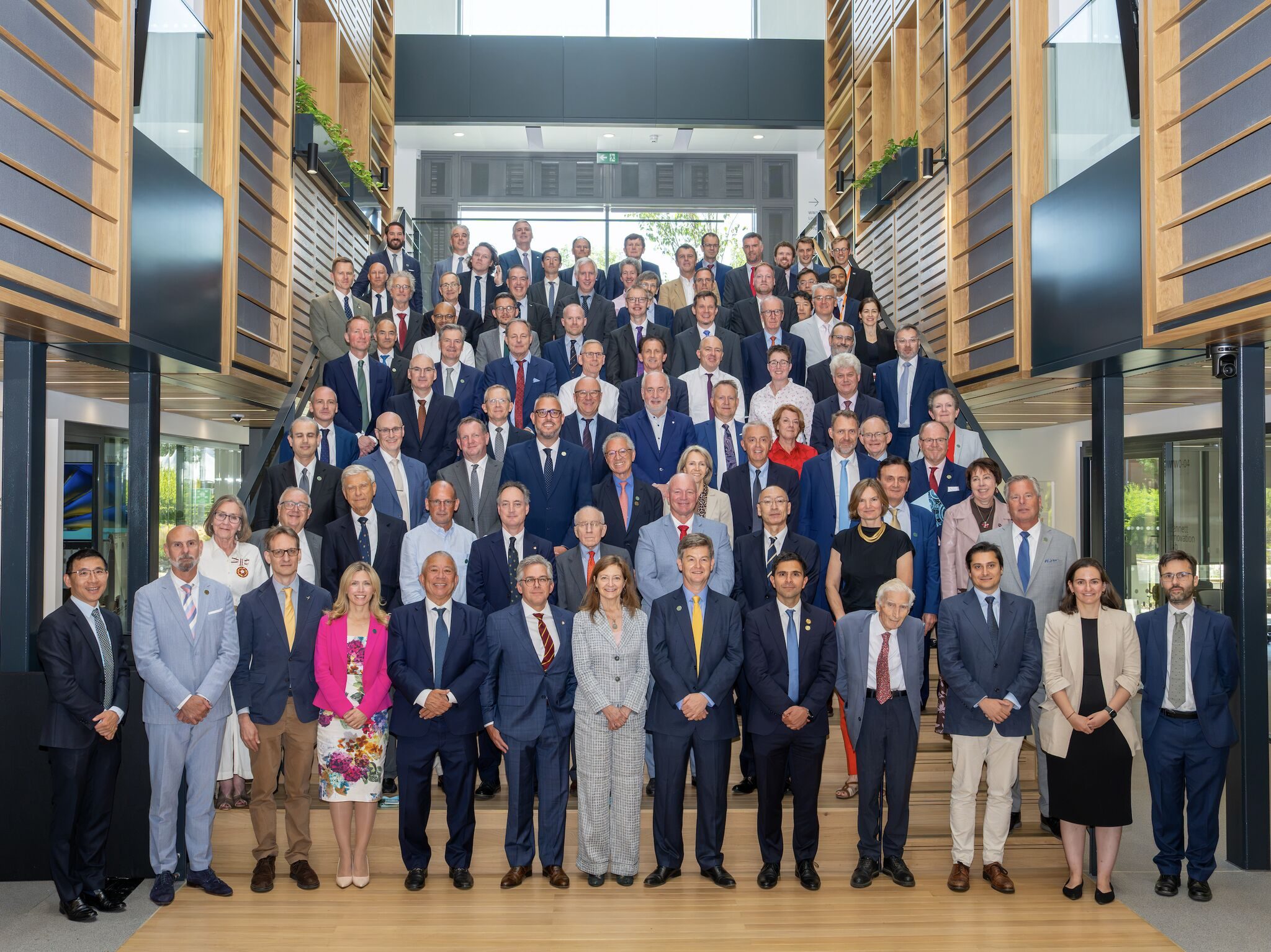
The opening of the New Whittle Laboratory and the inaugural Frank Whittle Summit marked an important moment for UK aerospace and deep technology. Around 80 CEOs and CTOs, 36 organisations, and an ambition that extends far beyond aerospace.
The Summit brought together leaders from aviation, energy, AI, finance, academia and government around a shared objective: defining practical national missions that can strengthen UK competitiveness. Congratulations to Professor Rob Miller, Dr Elliott Grant and everyone involved in creating what is clearly intended to become a long-term national capability — and in asking the right question:
How do we compress the time between breakthrough ideas and real-world deployment?
That message came through consistently throughout the day, and it reminded me of VentilatorChallengeUK. The UK does not lack world-class science. What it needs is the capability to move from research to certified, manufacturable technology in weeks and months rather than years — as we did during the COVID-19 pandemic.
The discussion was not simply about funding. It was about creating a national mission capability: connecting frontier AI, rapid experimentation, advanced manufacturing, industrial partners, investors and government into a single innovation pipeline.
His Majesty King Charles III opened the facility, toured it privately, and is Patron of the Laboratory. The Sustainable Markets Initiative — founded by the King, and a partner to the Whittle Laboratory since 2020 — described the shape of the day: “roundtable sessions bringing together 90 industry leaders, including CEOs and CTOs from leading global organizations, for a welcome presentation and two working discussions,” followed by a private tour and a ceremony for “over 160 attendees.”
The event hashtag, #ActionThisDay, is Churchill’s 1940 memo — sent to the Ministry of Aircraft Production after he was told Whittle’s jet engine could be scaled at speed. The framing is deliberate.
The Summit took place on the day the UK government changed. The King opened the laboratory hours after asking a new Prime Minister to form an administration, and Lord Vallance attended and resigned as Science Minister the same day.
The machinery of government changed with it. From 21 July 2026 the Department for Science, Innovation and Technology was abolished, its science and innovation policy moving into the Department for Business and Trade — renamed the Department for Business, Innovation, Science and Trade (DBIST) under Jonathan Reynolds, with a first Minister of State for Artificial Intelligence attending Cabinet.
So a set of industrial-policy proposals was assembled and published in the last hours of one departmental structure and the first of another. Whether by design or coincidence, the Summit’s argument — connect frontier AI, rapid experimentation and advanced manufacturing into one pipeline — landed on a department that was, the following morning, reorganised around exactly that combination.
Rapid iteration must replace incremental development if the UK is to lead in future industries. Shorten development cycles, learn faster, get technology into the real world sooner.
Future national missions will only succeed if they bring together academia, industry, investors and government around clearly defined outcomes — not isolated research programmes.
The opportunity is to better connect the Whittle Laboratory, ATI, Henry Royce Institute, High Value Manufacturing Catapult and regional innovation clusters into a seamless engineering ecosystem.
Hydrogen, superconductors, fusion, advanced manufacturing, AI, electrification and next-generation propulsion are increasingly part of the same technology landscape.
Transforming scientific leadership into industrial leadership will require sustained investment alongside engineering excellence.
Three technologies were demonstrated during the royal visit: the world’s first toroidal gas turbine, in which a single row of blades passes the flow repeatedly around a torus to achieve the pressure rise that multiple rows deliver conventionally; the Contrail Research Facility, which recreates the first moments of contrail formation under controlled conditions; and a prototype cryogenic jet engine burning supercooled liquid hydrogen, described by the University as “the biggest shift in jet engine design since Frank Whittle’s original design.”
A presentation board beside the cryogenic engine carried three figures under the heading Reduction in energy to fly.
Reduction in energy to fly
Advanced cryogenic jet engines · as presented, 20 July 2026
| Case | Fuel | Reduction |
|---|---|---|
| Maximum theoretical | — | 30% |
| Practical first engine | Hydrogen | 15% |
| Practical first engine | LNG | 7% |
Most attention will land on the 15%. The number worth reading is the 7%.
LNG boils at roughly 111 K; liquid hydrogen at 20 K. If the gain came principally from hydrogen’s combustion properties, the LNG case should largely collapse. It doesn’t — it retains close to half the benefit.
That points to the dominant mechanism being cold exergy — the fuel’s low temperature performing thermodynamic work inside the cycle before any of it is burned.
This is our reading of the published figures, not a claim the University has made. Two consequences follow if it is right. The architecture would be fuel-flexible: a 7% gain on LNG requires no hydrogen production, no liquefaction capacity and no airport hydrogen infrastructure — a nearer-term pathway sitting inside a hydrogen result. And cryogenic fuel becomes a system resource rather than a storage penalty: below about 20 K, cold has real cycle value, and the design question becomes how thoroughly you spend it.
“Energy to fly” is a system-level metric, and the board does not declare the control volume it is computed across. The accompanying schematic depicts a liquefaction plant and a cryogenic pipeline alongside the aircraft, which suggests a boundary wider than the engine — but suggestion is not declaration.
Hydrogen liquefaction in operating plants today consumes 11–13 kWh/kg against hydrogen’s lower heating value of 33.3 kWh/kg. If liquefaction sits inside the 15%, it is a strong whole-chain result. If it sits outside, it is a materially different claim. Nine patents have been filed; they should publish around late 2027 and will disclose the architecture.
One message was particularly encouraging. Superconductors, cryogenic engineering and hydrogen technologies were part of the mainstream discussion about the UK’s future industrial capability. Karim Amin of Siemens Energy set out the UK’s multi-vector position explicitly, naming “conventional nuclear, offshore wind, HVDC connectors and high-efficiency gas turbines with hydrogen co-firing capability to CCUS, SMRs, fusion and superconductors.”
That aligns directly with what we are developing:
These technologies do not sit alongside the UK’s future missions. They can help enable them.
The UK already possesses world-class universities, globally recognised industrial companies, real capability in AI for engineering and physical science, significant government support and growing investment capacity. The next challenge is ensuring the delivery ecosystem is equally strong.
Many of tomorrow’s breakthrough technologies will not originate inside multinational corporations. They will emerge from SMEs, university spin-outs, venture-backed deep-tech companies, specialist engineering consultancies, AI companies, advanced manufacturing businesses and regional innovation clusters. These organisations often move faster, explore higher-risk ideas, and bridge the gap between research and commercial deployment.
Large companies provide scale. Universities provide discovery. SMEs provide agility. The UK needs all three.
Developing fully superconducting, liquid-hydrogen-cooled electric propulsion requires expertise spanning cryogenics, superconductors, hydrogen systems, thermal management, AI-enabled engineering, aerospace certification and advanced manufacturing. No single organisation delivers that alone.
One change would significantly strengthen the initiative: a clear pathway for SMEs and start-ups to participate. Publish future national mission themes. Invite capability submissions from SMEs and university spin-outs. Establish technical working groups. Connect innovators with major industrial partners. Provide access to world-class facilities. Create demonstrator opportunities that accelerate commercial deployment.
Doing so would unlock innovation already being developed across the UK, strengthen domestic supply chains, and help scale breakthrough technologies.
39 individuals confirmed by a named public source, 10 reported but unconfirmed, 36 organisations — with the full method, exclusions and sources.
Footage of the King opening the New Whittle Laboratory and touring the demonstrations. Third-party upload; captions are auto-generated and the narration is not a reliable source.
The New Whittle Laboratory has been created to shorten the distance between ideas and deployment. That ambition deserves recognition. The opportunity now is to ensure delivery is as inclusive as the vision itself.
HyFlux looks forward to contributing to future collaborations in superconducting propulsion, liquid hydrogen systems, cryogenic technologies, advanced heat exchangers, AI-enabled engineering and zero-emission aviation. Congratulations again to everyone who made the inaugural Frank Whittle Summit possible.